

Dog Separation Anxiety: Why Independence Must Be Taught
- Stephanie Barger

- Mar 15
- 5 min read

Dog separation anxiety doesn’t develop because a dog is “too attached.”
It develops when a dog has not yet learned how to feel safe alone.
Independence is not something dogs automatically understand. It is not a personality trait. It is not something they simply “grow out of.” It is a skill that must be shaped thoughtfully and gradually.
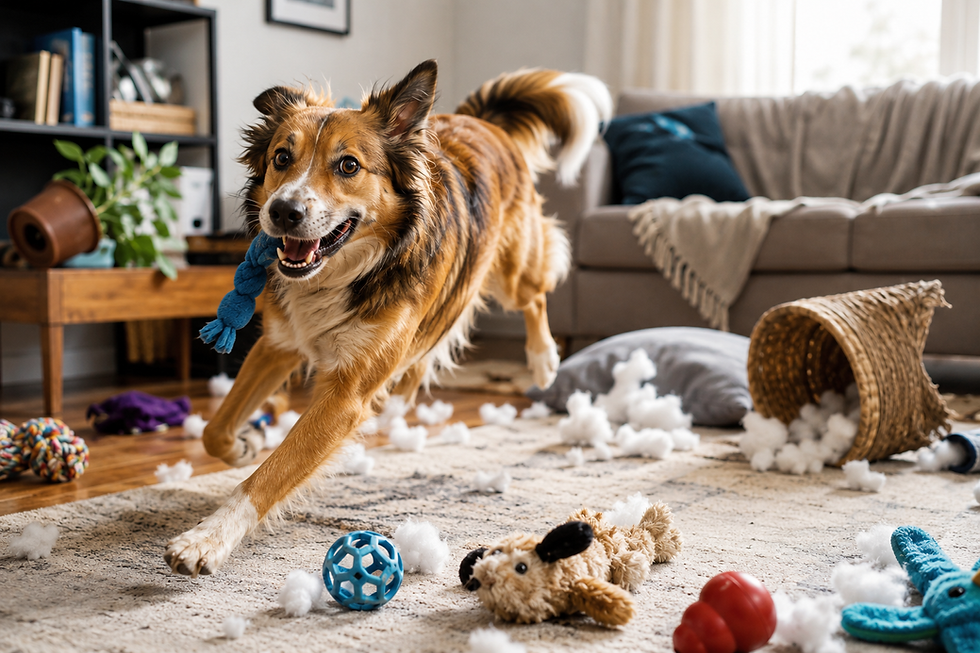
When we assume dogs should handle alone time without preparation, we often see the signs of dog separation anxiety emerge: vocalizing, destruction, pacing, drooling, escape attempts, or shutdown behaviors.
But these behaviors are not defiance. They are panic.
Understanding this distinction changes how we approach both prevention and recovery.
Dog Separation Anxiety Is About Emotional Safety, Not Distance
Physical absence is not the same as emotional security.
A dog can be physically separated from their guardian and feel safe. Or they can be physically separated and feel distressed. The difference lies in what their nervous system has learned about being alone.
Dog separation anxiety occurs when alone time predicts fear rather than safety.
This is why simply increasing duration rarely solves the problem. If the emotional experience remains stressful, duration only strengthens the panic response.
Teaching independence means changing the emotional meaning of alone time.
Why Independence Doesn’t Happen Automatically
Dogs are social animals. Their nervous systems are wired for connection.
While some dogs appear more naturally independent, even those dogs learn independence through experience. Puppies especially do not arrive with built-in coping skills for extended isolation.
Several factors influence the development of dog separation anxiety:
Early learning history
Gradual exposure (or lack of it)
Sudden lifestyle changes
Overwhelming absences
Temperament and sensitivity
Assuming independence without teaching it can unintentionally create distress.
This is not about blame. It is about awareness.
Responsible guardianship includes preparing dogs for the realities of daily life—including time alone.
The Myth of “They’ll Get Used to It”
One of the most persistent misconceptions about dog separation anxiety is the belief that dogs will eventually “get used to” being alone if we simply leave them long enough.
For dogs experiencing true separation anxiety, this approach often intensifies panic rather than resolves it.
Repeated overwhelming absences can:
Strengthen the anxiety response
Increase vocalization or destruction
Lower tolerance for shorter departures
Create generalized anxiety around pre-departure cues
Dog separation anxiety improves when the dog remains under their panic threshold—not when they are repeatedly pushed beyond it.
Tolerance is not the same as safety.
True progress happens when the nervous system learns that alone time is predictable and manageable.
What Teaching Independence Actually Looks Like
Dog separation anxiety prevention and treatment share the same foundation: gradual exposure paired with emotional safety.
Teaching independence involves:
Starting with durations the dog can handle comfortably
Watching emotional responses—not just time elapsed
Creating predictable departure and return routines
Avoiding sudden jumps in duration
Supporting the dog’s nervous system before, during, and after absences
Independence grows in small increments.
It is shaped through consistency, observation, and patience.
This is not indulgence. It is structured learning.
Supporting Capacity, Not Forcing Coping
Just as with dog behavior modification in other areas, capacity matters.
When a dog’s emotional capacity is exceeded, panic responses activate automatically. No amount of reasoning or repetition will override a nervous system in survival mode.
Dog separation anxiety improves when we build capacity gradually.
This includes:
Ensuring adequate daily rest
Reducing overall stress load
Supporting predictable routines
Avoiding unnecessary exposure to overwhelming situations
When the nervous system feels regulated, independence becomes more accessible.
Calm is not forced. It is supported.
Laying the Foundation Early: Faileas in Practice
With Faileas, independence work began quietly and intentionally.
Short, low-pressure separations were introduced without drama. The goal was never to “test” her limits, but to observe her emotional responses carefully.
If she showed hesitation, we slowed down. If she remained relaxed, we built gradually from there.
Pre-departure cues were kept neutral. Returns were calm and predictable. Durations increased in thoughtful increments.
These early experiences shape how her nervous system interprets absence.
Dog separation anxiety is far easier to prevent than to repair—but even for adult dogs already struggling, the same principles apply.
Gradual exposure. Emotional safety. Thoughtful pacing.
Independence is not rushed.
Independence Across Life Stages
Dog separation anxiety can appear at any age.
Puppies may struggle as they adjust to new homes. Adolescents may experience regression during developmental shifts. Adult dogs may develop anxiety following lifestyle changes, illness, relocation, or changes in household dynamics.
Independence is never a “one and done” lesson.
It is revisited throughout life.
Responsible planning includes anticipating transitions—new jobs, travel schedules, school changes—and preparing dogs gradually rather than waiting until stress emerges.
Proactive support reduces the likelihood of panic taking root.
Planning for Real Life
Modern life requires dogs to spend time alone.
Work schedules, appointments, errands, and travel are part of reality. Dog separation anxiety does not reflect failure—it reflects a gap in learning.
When we plan for absence intentionally, we reduce that gap.
This may include:
Practicing brief daily departures
Arranging support during longer unavoidable absences
Monitoring behavior through video
Adjusting duration based on emotional response
These steps are not excessive. They are thoughtful.
Teaching independence is an investment in your dog’s emotional wellbeing.
Dog Separation Anxiety Is Treatable
If your dog is already experiencing dog separation anxiety, hope is not lost.
With structured, gradual exposure and careful observation, many dogs learn to feel safe alone. Progress may not be linear, but it is possible.
Dog separation anxiety work requires patience and precision. It requires resisting the urge to rush. And it requires compassion for both the dog and the guardian navigating the process.
True independence is not built through endurance. It is built through safety.
Creating Calm Through Preparation
Independence is one of the greatest gifts we can give our dogs.
Not because we need them to be separate—but because emotional security strengthens every aspect of their lives.
When alone time feels safe, dogs become more resilient overall. They recover more quickly from stress. They show greater flexibility. Their confidence grows.
Dog separation anxiety reminds us that preparation matters.
Calm does not appear by accident. It is cultivated through thoughtful, consistent support.
Support for Dog Separation Anxiety
If your dog struggles with barking, destruction, panic, or distress when left alone, you are not alone.
Through structured virtual dog training and dog separation anxiety support, we can build a gradual plan tailored to your dog’s emotional capacity and your real-life schedule.
Dog separation anxiety improves when we combine science, patience, and compassion.
Independence is taught—not assumed.
And calm is built, one step at a time.
About Stephanie Barger
Stephanie Barger approaches dog training as a shared learning process between dogs and their humans. Specializing in separation anxiety and behavior modification, she helps guardians move beyond frustration and confusion toward understanding and connection.
Drawing from her background in education, Stephanie focuses on teaching guardians how to observe, interpret, and respond to their dog’s behavior with intention. She recognizes that many unwanted behaviors are signs of stress or unmet needs, not defiance or stubbornness. By reframing behavior through this lens, guardians are better equipped to support real change.
Stephanie’s work centers on building emotional safety, strengthening communication, and creating sustainable routines that fit each household’s unique needs. Her goal is not perfection, but progress—helping dogs and humans live together with more ease, trust, and mutual respect.
Free Clarity Call with Stephanie:
Subscribe to Newsletter:
Stephanie and Canine Zen's links/handles:
Facebook (personal): https://www.facebook.com/StephanieBarger67
Facebook (business): https://www.facebook.com/caninezenusa/
Instagram: https://www.instagram.com/caninezen/
Stephanie’s Certifications/Organizational Affiliations:
Certified Separation Anxiety Trainer (CSAT)
Certified Behavior Consultant (CBCC-KA)
Certificate of Completion-Aggression in Dogs Master Class
Fear Free Certified Professional (FFP-Trainer)
Certified Professional Dog Trainer (CPDT-KA)
Member of the Association of Professional Trainers (APT)
Member of the International Association of Animal Behavior Consultants (IAABC)
Member of the Pet Professional Guild (PPG)
Alignable Ambassador: Alliance of Central NM
Alignable Group Co-Leader: Pet Industry Group
Owner/Operator of Canine Zen LLC


Comments